

Click for Table of Contents
- Which portable long service leave schemes operate in Queensland?
- Who has to register with QLeave for community services?
- What is the difference between ordinary wages and annual rate of pay?
- What counts as ordinary wages for QLeave?
- When are QLeave returns due?
- What do workers get?
- How does the contract cleaning scheme work?
- How does the building and construction scheme work?
- Why does QLeave reporting take so long?
- How can you do your Queensland return in minutes?
- What if you employ staff in other states?
- FAQs about portable long service leave in Queensland
- See it in action
- Who is Pay Cat?
Updated October 2026.
QLeave runs three portable long service leave schemes in Queensland: community services, contract cleaning, and building and construction. This guide is for payroll, HR and finance teams at Queensland employers, and it covers who has to register, what each levy costs, what to report as ordinary wages and annual rate of pay, and when returns are due, as at October 2026.
Your next community services and contract cleaning returns, for July to September 2026, are due on 14 October 2026.
New in Pay Cat
Payroll reports, minus the spreadsheet scramble
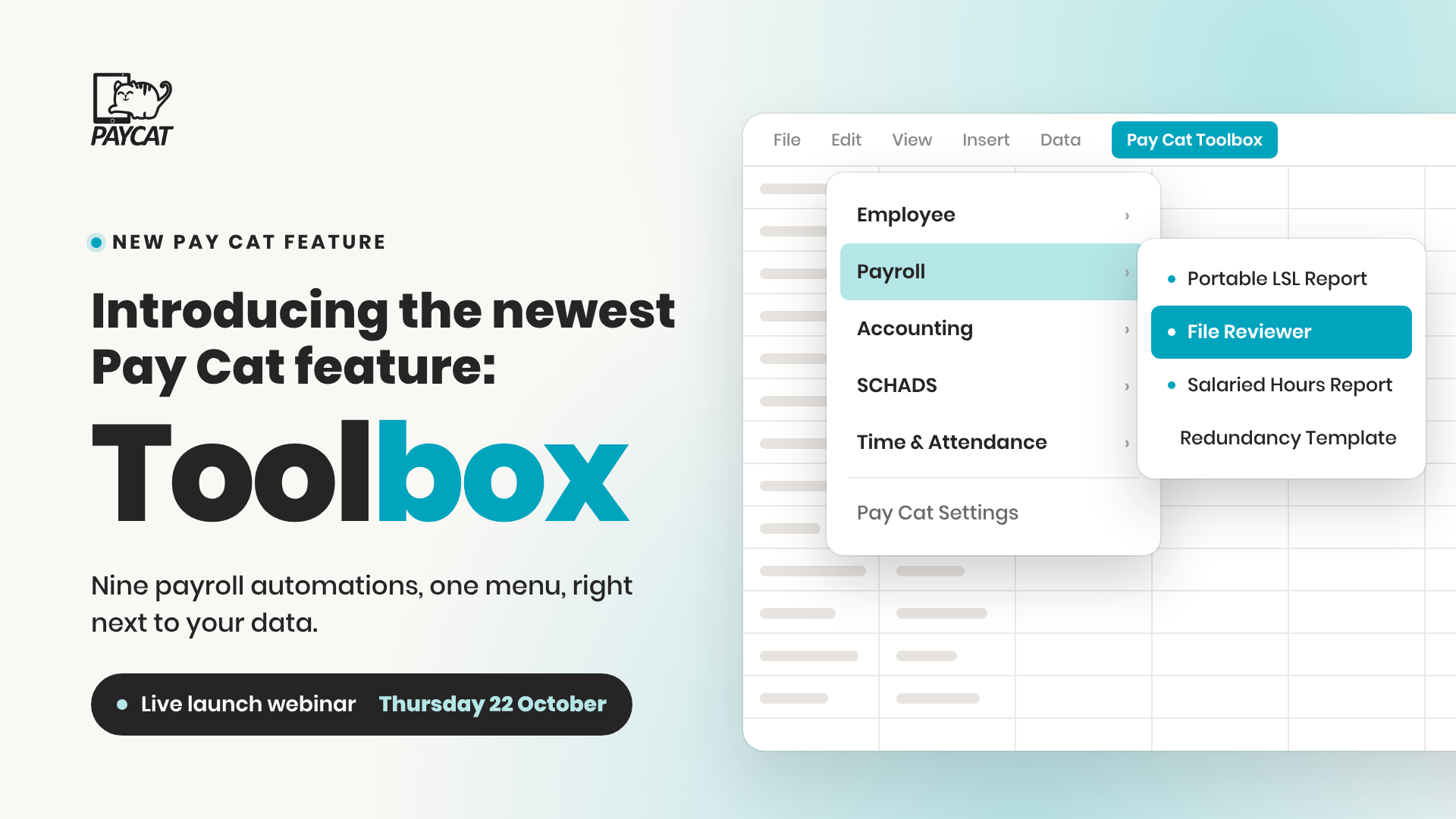
Meet Pay Cat Toolbox, the new feature with 9 tools to run payroll reports faster, including portable long service leave. See it live at the free launch webinar on 22 October at 12pm AEDT (online).
Which portable long service leave schemes operate in Queensland?
| Industry | Started | Levy | What you lodge |
| Community services | 1 January 2021 | 1.35% of ordinary wages | Quarterly return and levy |
| Contract cleaning | 1 July 2005 | 0.5% of ordinary wages, from 1 July 2026 | Quarterly return and levy |
| Building and construction | Long-running scheme | 0.35% of the project cost, paid by the project owner | Annual worker service return |
Rates as published by QLeave, as at October 2026. The contract cleaning levy dropped from 0.75% to 0.5% on 1 July 2026.
Who has to register with QLeave for community services?
Employers whose workers perform community services work, or support, supervise or manage it, must register with QLeave within 28 days of becoming an employer. The scheme started on 1 January 2021, under the Community Services Industry (Portable Long Service Leave) Act 2020.
It covers full-time, part-time and casual employees, as well as contract and labour hire workers and sole traders, across more than 25 service types, including disability, accommodation support, child safety and alcohol and other drug services. Government workers, standalone childcare and early childhood services, and standalone aged care are excluded. Source: QLeave, as at October 2026.
Include every eligible worker who worked five or more days in the quarter.
What is the difference between ordinary wages and annual rate of pay?
Queensland community services employers report two figures for every worker each quarter, and they're easy to mix up. Ordinary wages is what the worker was actually paid, and it's what the 1.35% levy is charged on. Annual rate of pay is the worker's minimum award rate, annualised, and QLeave uses it to work out the value of their leave.
| Ordinary wages | Annual rate of pay | |
| What it is | What the worker was actually paid in the quarter | The worker's minimum award rate for their classification and pay point, annualised |
| Used for | Calculating the 1.35% levy | Working out the value of the worker's leave |
| Hours basis | Hours actually worked and paid | Full-time hours, even for part-time and casual workers |
| Penalties, allowances, casual loading | Included, except overtime, leave loading and expense allowances | Excluded |
The annual rate of pay is the weekly award wage times 52, or the hourly award rate times full-time hours times 52, as at the end of the quarter. Source: QLeave, annual rate of pay, page reviewed 27 April 2026.
So for a casual support worker, you report what they actually earned as ordinary wages, then their SCHADS classification and pay point rate, annualised as if they worked full time, as their annual rate of pay. Each time someone moves up a pay point, the annual rate of pay changes too.
What counts as ordinary wages for QLeave?
Ordinary wages is the amount paid to a community services worker under their award, agreement or contract. As at October 2026, QLeave includes and excludes the following:
| Included | Excluded |
| Award and over-award wages | Overtime |
| Weekend and public holiday penalty rates, when worked as ordinary hours | Expense allowances (equipment, materials, protective clothing, vehicle) |
| Shift, on-call, sleepover, first aid and leading hand allowances | Leave loading |
| Annual, sick, long service, parental (employer paid), personal and bereavement leave | Bonuses and ex-gratia payments |
| Casual loading | Lump sum termination payments and redundancy |
| Salary sacrifice amounts | Superannuation |
| Employer-paid workers' compensation and jury service | Commonwealth Paid Parental Leave |
Source: QLeave, how to calculate ordinary wages, as at October 2026. Contract cleaning uses a similar list, but cleaning employers don't report an annual rate of pay.
When are QLeave returns due?
Community services and contract cleaning returns, and the levy, are due 14 days after each quarter ends:
| Quarter | Return and levy due |
| 1 July to 30 September 2026 | 14 October 2026 |
| 1 October to 31 December 2026 | 14 January 2027 |
| 1 January to 31 March 2027 | 14 April 2027 |
| 1 April to 30 June 2027 | 14 July 2027 |
You lodge through the QLeave employer portal, either worker by worker or by exporting the spreadsheet, filling in the gross ordinary wages and annual rate of pay columns, and importing it back. Late returns and late levies each attract one penalty unit, which is $172.70 from 1 July 2026, with double penalties for a repeat within 12 months and a further penalty for each month it stays outstanding. Source: QLeave, penalties, as at October 2026.
What do workers get?
Community services workers can take 6.1 weeks of long service leave once they have seven years of service recorded with QLeave. A worker is credited with one day of service for every day in a quarter in which they did any community services work, up to 365 days a year. Contract cleaning workers get 8.67 weeks after 10 years of service. Source: QLeave and the Community Services Industry (Portable Long Service Leave) Act 2020, as at October 2026.
How does the contract cleaning scheme work?
Contract cleaning employers must register with QLeave within 7 days of becoming an employer in the industry. The levy is 0.5% of ordinary wages from 1 July 2026, down from 0.75%. Returns follow the same quarterly due dates as community services, and you must still lodge a nil return in a quarter when no workers earned wages. Source: QLeave, contract cleaning levy, as at October 2026.
How does the building and construction scheme work?
Queensland's building and construction scheme isn't funded from payroll. The project owner pays a 0.35% portable long service leave levy (0.575% in total, with the safety and training levies) on building work costing $150,000 or more, before the work starts. Employers lodge an annual worker service return, due 31 July each year, recording each worker's days of service. Workers can claim 8.67 weeks of leave after 2,200 service credits. Source: QLeave, as at October 2026.
Why does QLeave reporting take so long?
Every quarter, you need two different numbers for every worker. Ordinary wages has to be built from the right pay categories, keeping weekend penalties and casual loading but removing overtime, leave loading and expense allowances. Annual rate of pay has to come from each worker's current classification and pay point, annualised on full-time hours, which your payroll reports don't show. If you report in another state, you do it all again under that state's rules.
How can you do your Queensland return in minutes?
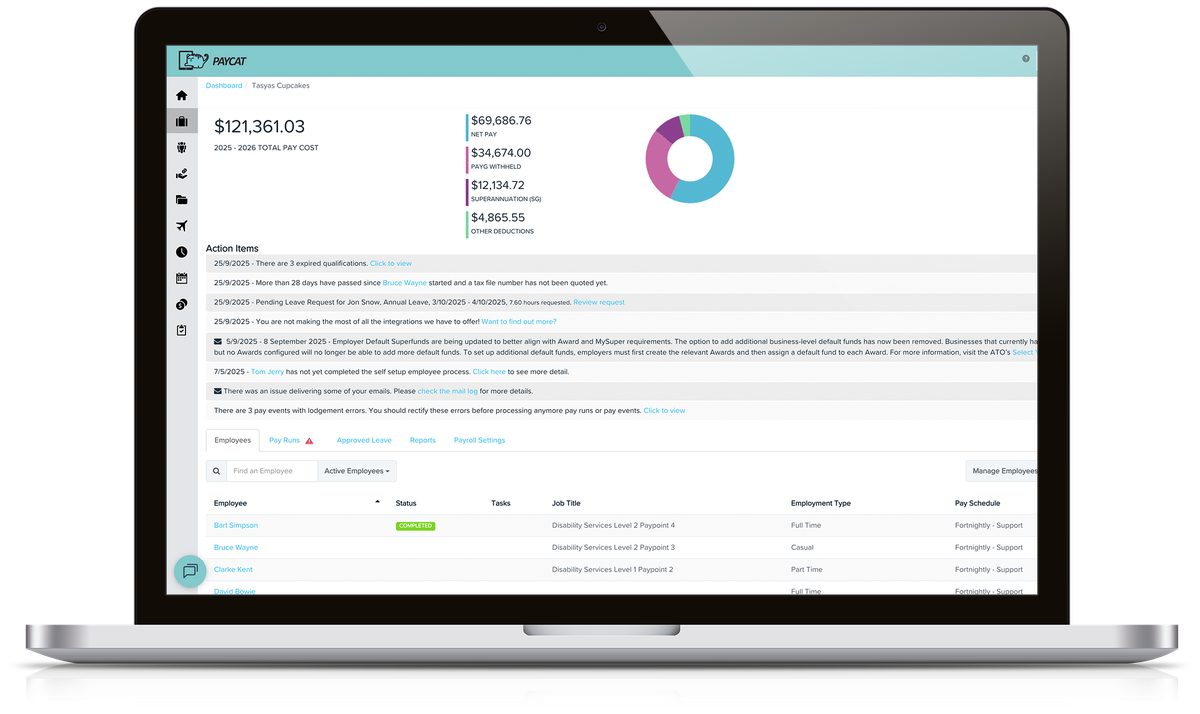
Pay Cat Toolbox's portable long service leave report pulls each worker's wages for the period straight from your Pay Cat Payroll file, applies the pay categories that are reportable for your scheme, and fills in both the ordinary wages and annual rate of pay columns for the QLeave spreadsheet import. You map your pay categories once. We pre-tick the ones that are reportable for QLeave, and flag the few you need to decide.
Toolbox covers every state and territory scheme, so if you employ staff across borders, one report handles each scheme's rules. It costs $2 per active employee per month, added to your existing Pay Cat Payroll plan.
Free webinar replay
See a portable LSL return built live
Tasya, our Head Trainer, runs the Pay Cat Toolbox portable LSL report on a real file, from pay categories to upload file.
What if you employ staff in other states?
Each state and territory runs its own schemes, with its own wage rules and due dates, and you report to each one separately. Read our guides for NSW, Victoria, South Australia and the ACT.
FAQs about portable long service leave in Queensland
When is the next QLeave return due?
Community services and contract cleaning returns for 1 July to 30 September 2026 are due on 14 October 2026. QLeave returns and levies are due 14 days after the end of each quarter.
What is the QLeave community services levy rate?
As at October 2026, the QLeave community services levy is 1.35% of workers' ordinary wages. The contract cleaning levy is 0.5% from 1 July 2026, down from 0.75%.
What is the annual rate of pay on a QLeave return?
Annual rate of pay is the annual minimum wage for a community services worker's award classification and pay point, worked out on full-time hours even if the worker is part-time or casual. It excludes overtime, casual loading and allowances. QLeave uses it to work out the value of leave, not to calculate the levy.
Does QLeave ordinary wages include penalty rates?
Yes. Weekend and public holiday penalty rates are included in ordinary wages when they are worked as ordinary hours. Overtime, leave loading and expense allowances are excluded.
Do casual workers need to be included on a QLeave return?
Yes. Include every eligible community services worker who worked five or more days in the quarter, whether they are full-time, part-time or casual.
See it in action
Tasya, our Head Trainer, walked through portable long service leave reporting in our PLSL & SCHADS Leave Entitlements Webinar.
Free webinar replay
PLSL & SCHADS Leave Entitlements Webinar
Tasya, our Head Trainer, walks through portable long service leave and SCHADS leave entitlements, then shows how the Pay Cat Toolbox PLSL report turns your pay data into a return ready to lodge.
Watch the replaySee how the PLSL report works
Not on Pay Cat Payroll yet? Book a demo and we'll show you how it works.
Who is Pay Cat?
Pay Cat are payroll specialists for SCHADS and community services employers. Pay Cat Payroll runs on our SCHADS Award template, which interprets the award automatically, and Pay Cat Toolbox adds the reports payroll teams usually build by hand, including portable long service leave returns.
Video: How Pay Cat helps NDIS providers simplify SCHADS and portable long service leave compliance.