

Click for Table of Contents
The Cleaning Services Award is a complex and regularly updated Modern Award that applies across the contract cleaning industry in Australia, and it's easy for even experienced payroll teams to miss an update.
You can download a FREE copy of our Cleaning Services Award eBook that covers everything you need to know about the award, without the jargon, including classification tables and pay rate cheat sheets.
If you're after more detail on the industry itself, you can also visit our Cleaning Services industry page.
This summary will give you a comprehensive understanding of the Cleaning Services Award so you can pay your team correctly, every pay run.
Disclaimer:
Please note that every effort has been made to ensure that the information provided in this guide is accurate. You should note, however, that the information is intended as a guide only, providing an overview of general information available. This guide is not intended to be an exhaustive source of information and should not be seen to constitute legal or tax advice. You should, where necessary, seek a second professional opinion for any legal or tax issues raised in your business affairs.
Coverage
Examples of businesses covered by the Cleaning Services Award include:
- office cleaners employed by contract cleaning businesses
- shopping centre cleaners employed by contract cleaning businesses
- specialist cleaning businesses (gutter cleaning, restoration, damaged property cleaning)
- trolley collectors working for contract trolley businesses
- event cleaning services
- hygiene and pollution control services.
However, the Cleaning Services Award does NOT cover:
- cleaners directly employed by retail businesses or hotels
- car washers and detailers
- laundry and dry-cleaning services
- cleaning at civil construction premises
- trolley collectors employed directly by retail businesses.
Types of Employment
- Full-time
- Part-time; or
- Casual
Full-Time Employees
To be classified as a full-time employee under the Cleaning Services Award, they must work an average of 38 ordinary hours per week. This can be arranged as:
- 5 days of 7.6 hours each per week
- 19 days of 8 hours each per month; or
- up to 10 hours on any day by agreement.
Part-Time Employees
Part-time employees work fewer than 38 hours per week but are entitled to the same benefits as full-time employees on a pro-rata basis, meaning entitlements are calculated in proportion to the hours they work.
Example A full-time employee is entitled to 4 weeks (152 hours) of annual leave a year. A part-time employee working 19 hours a week (half of full-time hours) is entitled to half that leave, which is 76 hours a year.
Part-time employees must have a written agreement with their employer specifying:
- the number of hours to be worked each day
- the days of the week they will work; and
- their start and finish times.
15% Part-Time Loading On top of pro-rata entitlements, part-time employees are paid at 115% of the relevant full-time hourly rate for their classification, a 15% loading applied before any penalty rates.
Example A Level 1 part-time employee's minimum hourly rate is $31.14. That's $27.08 plus the 15% loading, before any penalty rates are applied.
THE FREE CLEANING SERVICES AWARD EBOOK
Download our eBook on the Cleaning Services Award (without the jargon), including classification tables and pay rate cheat sheets.
Download the eBook
Casual Employees
Casual employees do not have a fixed schedule or minimum hours, and their hours can fluctuate week to week depending on the needs of the business.
25% Casual Loading To compensate for the lack of entitlements like paid annual leave and personal/carer's leave, casual employees receive a 25% casual loading on top of the minimum hourly rate for their classification.
Example If a full-time or part-time cleaner in a particular classification has a minimum hourly rate of $25, a casual employee performing the same role is entitled to a minimum hourly rate of $31.25 ($25 plus the 25% loading).
Minimum Engagement Periods Casual and part-time employees are entitled to minimum shift durations based on the total cleaning area of the location they're working at:
| Cleaning Area | Minimum Shift Duration |
|---|---|
| Up to 300 sq m | 1 hour* |
| Up to 2,000 sq m | 2 consecutive hours |
| 2,000 to 5,000 sq m | 3 consecutive hours |
| 5,000 sq m or more | 4 consecutive hours |
*Only applies when the employee is the sole worker at a small stand-alone site and it's not practical to work a longer shift across multiple locations.
Employees must be paid for the full minimum shift duration even if they finish their work sooner.
Example: Tom, a casual cleaner, is rostered to work at a school with a total cleaning area of 1,800 square metres. The minimum engagement period is 2 hours, so Tom must be rostered for at least 2 consecutive hours and paid accordingly, even if he finishes his duties in 1.5 hours.
Right to Request Casual Conversion Casual employees who have worked a regular pattern of hours on an ongoing basis over the previous 6 months, with the same employer for at least 12 months, may request conversion to permanent full-time or part-time employment. The employer must respond in writing within 21 days, and if they refuse the request, they must give reasonable grounds.
Back to top
Hours of Work
Ordinary Hours for Full-Time Employees
Full-time ordinary hours (an average of 38 hours per week) can be arranged as:
- 5 days of 7.6 hours each per week
- 152 hours per 4-week cycle with rostered days off (up to 12 per year)
- 19 days of 8 hours each per month; or
- up to 10 hours on any day by agreement between the employer and the majority of employees.
These arrangements can only be changed with a minimum of one week's notice, except in emergencies, and can't be altered during an ongoing cycle.
Ordinary Hours for Part-Time and Casual Employees
Part-time and casual employees can work shifts of up to 7.6 hours per day, for a maximum of 5 days per week, subject to the minimum engagement periods outlined above.
Rostering
- The employer must prepare a roster showing each employee's name and work start/finish times.
- The roster must be posted in a conspicuous, easily accessible place.
- Rosters can be changed at any time by mutual agreement, or with 7 days' notice (shorter in emergencies).
- Roster changes must be recorded in the employee's time and wages records.
Shiftworkers
Employees who work shifts that attract a shift penalty under the award are considered shiftworkers, and are entitled to:
- a paid meal break of at least 20 minutes per shift, taken between 4 and 5 hours after the shift starts (this counts as time worked); and
- full-time shiftworkers working a straight shift are also entitled to one additional 10-minute paid rest break per shift (this also counts as time worked).
Non-Shiftworkers
Employees not entitled to a paid meal break under the shiftworker provisions are entitled to:
- an unpaid meal break of between 30 minutes and 1 hour, and cannot be required to work more than 4½ hours (5 hours in an emergency) without one; and
- a 10-minute paid morning rest break and a 10-minute paid afternoon rest break, both of which count as time worked.
Breaks Between Shifts
Employees must have a minimum break of 8 consecutive hours between finishing one shift of ordinary hours (including any immediately following overtime) and starting the next. If an employer requires an employee to start work without this break, the employee must be paid at the overtime rate until released from duty for at least 8 consecutive hours, without losing any pay for ordinary hours not worked during that release period.
Interrupted and Overtime Meal Breaks
- If an employee's meal break is interrupted and they're directed to work, the employer must pay overtime rates until they can resume their break.
- An employee working overtime is entitled to a paid 20-minute meal break after each 4 hours of overtime worked.
Days Off
All employees are entitled to 2 consecutive full days off within each 7-day cycle.
Employee Right to Disconnect
From 26 August 2024 (or 2025 for small businesses), employees have the right to disconnect from work outside their working hours. This means they can refuse to monitor, read, or respond to work-related contact from their employer or third parties during their off-hours, unless it's unreasonable to do so. Employers can still contact workers outside working hours for emergency roster changes or recalls to work.
Minimum Rates
Each new financial year brings a change to the National Minimum Wage and the Award Minimum Wages, and the Cleaning Services Award rates were updated effective 1 July 2026.
The award outlines classifications from CSE Level 1 through to CSE Level 3, based on an employee's duties, responsibilities and level of supervision. Each level has a corresponding minimum pay rate, and employers must pay at least the applicable minimum for the classification and level.
If you aren't sure about the classification structure, we break it down (with a full classification table) in our Cleaning Services Award eBook.
Adult base hourly rates (effective 1 July 2026)
| Classification Level | Full-time | Part-time | Casual |
|---|---|---|---|
| Level 1 | $27.08 | $31.14 | $33.85 |
| Level 2 | $27.97 | $32.17 | $34.96 |
| Level 3 | $29.45 | $33.87 | $36.81 |
Superannuation and Payday Super
Superannuation
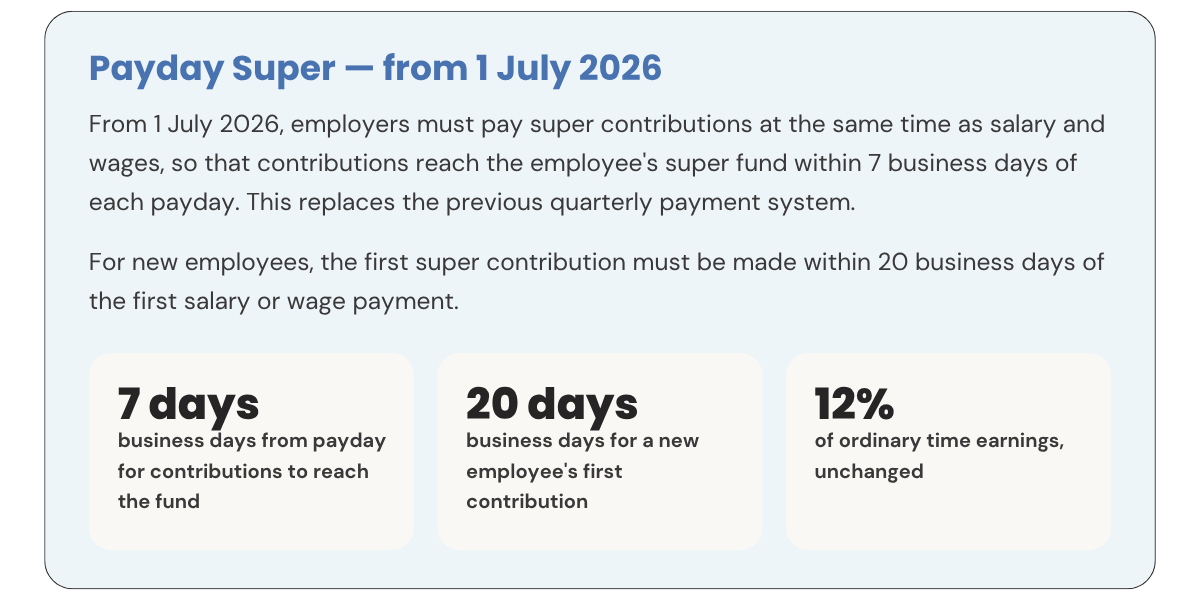
From 1 July 2025, the Superannuation Guarantee (SG) rate increased to 12% of an employee's ordinary time earnings, and it stays at 12% for 2026-27. This rate applies to all salary and wages paid on or after 1 July 2025, even if some or all of the pay period occurred before that date.
Before 1 July 2022, you only needed to pay super guarantee if you paid your worker $450 or more (before tax) in a month. As of 1 July 2022, employers are required to pay super guarantee for all eligible employees, regardless of how much they are paid.
Payday Super
From 1 July 2026, Payday Super changed how and when super is paid. Instead of paying quarterly, employers must pay super guarantee at the same time as wages, for every payday. The contribution needs to reach the employee's super fund within 7 business days of payday (this is not same-day super, just a tighter deadline), and it's calculated on the employee's qualifying earnings rather than only ordinary time earnings. Missing the 7-day window can trigger the new super guarantee charge, including an added administrative uplift penalty on top of the shortfall.
WEBINAR ON-DEMAND
Pay Day Super is Here, is Your Payroll Ready? Pay Cat Head Trainer Tasya walks through exactly what's changed, what it means for your payroll, and how to get set up with the right clearing house solution.
Overtime and Penalty Rates
Full-time employees must be paid overtime for any hours worked in excess of their ordinary hours. For part-time and casual employees, all time worked beyond 7.6 hours per day, 5 days a week, or 38 hours in any week is overtime. Overtime worked on any day stands alone and is not cumulative across multiple days.
Overtime rates
| Overtime worked on | Full-time and part-time | Casual (incl. loading) |
|---|---|---|
| Monday to Saturday, first 2 hours | 150% | 175% |
| Monday to Saturday, after 2 hours | 200% | 225% |
| Sunday, all day | 200% | 225% |
| Public holiday, all day | 250% | 275% |
Time Off Instead of Overtime
An employer and employee can agree in writing for the employee to take time off instead of being paid for overtime. Time off must be taken within 6 months of the overtime being worked, at a time agreed by both parties. If it isn't taken within 6 months, the employer must pay the employee for the overtime worked.
Example: Jane, a full-time cleaner, works 2 hours of overtime on a Monday and agrees with her employer in writing to take time off instead of being paid. If Jane doesn't take the time off within 6 months, her employer must pay her for the 2 hours of overtime at the applicable rate in the next pay period.
Penalty Rates
Penalty rates apply on top of the minimum hourly rate for hours worked at specified times or on certain days, and are separate from overtime rates.
| Period or Day | Full-time | Part-time (incl. loading) | Casual (incl. loading) |
|---|---|---|---|
| Mon–Fri shift starting before 6am or finishing after 6pm (excl. public holidays) | 115% | 130% | 140% |
| Shift finishing after midnight, no later than 8am (excl. public holidays) | 130% | 130% | 155% |
| All hours midnight Fri to midnight Sat | 150% | 165% | 175% |
| All hours midnight Sat to midnight Sun | 200% | 215% | 225% |
| All hours on a public holiday | 250% | 265% | 275% |
Example: Margaret, a part-time Level 1 employee, works 5-hour shifts on Friday, Saturday and Sunday from 6pm to 11pm, at a minimum hourly rate of $31.14.
- Friday night shift (130%): $40.48/hour x 5 hours = $202.40
- Saturday shift (165%): $51.38/hour x 5 hours = $256.90
- Sunday shift (215%): $66.95/hour x 5 hours = $334.75
Total for the week: $794.05.
Call Back
If an employee is recalled to work overtime after completing their ordinary hours and leaving the employer's premises, they must be paid for a minimum of 2 hours at the overtime rate, even if they work less than that.
Call back for non-cleaning purposes If an employee is required to return to work for administrative duties or a disciplinary/counselling interview, they must be paid at the appropriate rate for a minimum number of hours, depending on the day:
| Day | Rate | Minimum Hours |
|---|---|---|
| Monday to Friday | Ordinary hours rate or applicable penalty | 2 hours |
| Saturday | Appropriate Saturday rate | 3 hours |
| Sunday | Appropriate Sunday rate | 4 hours |
This does not apply if the attendance is continuous with ordinary hours or overtime, or if it's for paid training.
Allowances
The Cleaning Services Award includes a number of allowances to compensate employees for specific working conditions. Rates below apply from 1 July 2026.
| Allowance | When it applies | Rate |
|---|---|---|
| Broken Shift Allowance | Two periods of duty in a day with a break of more than one hour (excl. meal and rest breaks) | $4.71 per day (max $23.56 per week) |
| Cold Work Allowance | Working more than 1 hour in temperatures artificially reduced below 0°C | $0.69 per hour |
| Hot Work Allowance (46°C-54°C) | Working more than 1 hour in temperatures artificially raised between 46°C and 54°C | $0.69 per hour |
| Hot Work Allowance (over 54°C) | Working more than 1 hour in temperatures artificially raised above 54°C | $0.83 per hour |
| Height Allowance (up to 22nd floor) | Cleaning from a swing scaffold, boatswain's chair or similar device | $1.11 per hour or part thereof |
| Height Allowance (above 22nd floor) | As above, above the 22nd floor | $2.27 per hour or part thereof |
| First Aid Allowance | Qualified first aiders appointed in writing | $16.87 per week |
| Leading Hand Allowance (1-10 employees) | In charge of other workers | $61.73 per week |
| Leading Hand Allowance (11-20 employees) | In charge of 11 to 20 workers | $79.43 per week |
| Leading Hand Allowance (20+ employees) | In charge of more than 20 workers | $97.13 per week |
| Refuse Collection Allowance | Majority of shift collecting, disposing of or sorting refuse, or feeding an incinerator, furnace or compactor | $4.69 per shift |
| Toilet Cleaning Allowance | Primarily engaged in cleaning toilets for the majority of a shift | $3.69 per shift, or $18.17 per week |
| Meal Allowance | Required to work 2+ additional hours without prior notice and no meal provided | $17.53 per occasion |
| Vehicle Allowance (motor vehicle) | Using own motor vehicle for work duties by agreement | $1.01 per km |
| Vehicle Allowance (motorcycle) | Using own motorcycle for work duties by agreement | $0.34 per km |
| Uniform Allowance | Cost of required uniform not supplied or paid for by employer | Reimbursement of actual cost |
| Travel Time and Travel Allowance | Time spent travelling between workplaces | Reimbursement of actual cost |
Search our allowance database for all relevant allowances to your modern award.
Leave Entitlements
Annual Leave
- 4 weeks per year for full-time and part-time employees
- 5 weeks for shift workers
- Paid the higher of 17.5% leave loading or the shift penalties they would have received, whichever is greater
- Can be taken in advance by agreement
- Excessive leave provisions apply after 8 weeks' accrual
Personal/Carer's Leave
- 10 days paid leave per year, accumulating progressively
- Medical certificate required after 2 consecutive days
- Unpaid carer's leave available for casuals
Long Service Leave
- Based on state/territory legislation
- Generally 8.67 weeks after 10 years' service
- Pro-rata entitlements may apply earlier
Supported Wage System
Employees who, because of a disability, are unable to perform the full range of duties for their classification may be eligible for a supported wage under the award.
Eligible employees are paid a percentage of the relevant minimum wage matching their assessed productive capacity, on a sliding scale from 10% to 90% in 10% increments, assessed using the Supported Wage System Handbook (jobaccess.gov.au). Regardless of the assessed percentage, the minimum amount payable is $113 per week.
Back to top
Public Holidays
Full-time and part-time employees are entitled to a day off with pay on public holidays.
Work on a public holiday is paid at 250% (full-time and part-time) or 275% (casual, including casual loading) of the ordinary rate. Substitute days can be agreed between the employer and employee.
Want to Cut Your Payroll Processing Time by Up to 90%?
Many of our clients skip the manual process altogether and make the shift to Pay Cat Payroll (powered by Employment Hero), with our team managing the transition for you.
Here's how Pay Cat Payroll works:
- Timesheet Approvals On the Go
No more manual entries or paper timesheet approvals. Supervisors and managers approve timesheets on the go, directly in Pay Cat Payroll.
- Automated Modern Awards Compliance
Pay Cat Payroll's pre-built modern Awards make it easy for payroll managers to pay staff correctly, each and every pay run.
- Automated Payslips
Create and customise Fair Work compliant payslips that are easy to access in Pay Cat Payroll.
- Cut Payroll Processing Time by Up to 90%
No back pay calculations. No inefficient manual interpretation. No data re-entry. Just faster, stress-free paydays.
If you’re interested in moving from a manual payroll system to Employment Hero Payroll, get in touch with us today for a free demo.