
Click for Table of Contents
- Conversion From Casual to Full-Time or Part-Time Employment
- Full-Time Employees Cannot Work More Than 10 Consecutive Days
- Rosters Must Be Displayed Somewhere Everyone Can Easily See It
- Meal Breaks Must Be Taken Within the First 6 Hours of a Shift
- Penalty Rates Aren’t Just for Weekends and Public Holidays
- Deducting Wages for Breakages
- Superannuation & Payday Super
- Notice of Temporary Close-Downs
- Rests Between Shifts
- Want to Cut Your Payroll Processing Time by Up to 90%?
The Hospitality Award (MA000009) is one of the more complex modern awards in the Australian employment landscape due to a large number of businesses it covers and the nature of work within the industry.
This includes employers and employees in:
- Hotels and resorts
- Motor inns and motels
- Health or recreational farms
- Caravan parks
- Ski lodges
- Holiday flats or units, ranches or farms
- Hostels or any other type of residential or tourist accommodation
- Caterers
- Bars and restaurants
- Casinos
- Function areas
- A range of other related businesses
Recently there has been a push in media coverage and attention from Fair Work Australia regarding payroll compliance. Therefore, it’s critical to understand how many obligations and potential problems there are if employers aren’t fully aware of their responsibilities in meeting the Hospitality Award (MA000009) requirements.
While everyone does have access to industry awards on the Fair Work website, they can be tricky to understand as they’re jammed full of legal jargon.
Here we’ll cover some of the conditions that you might not have heard about from the Hospitality Award that are commonly missed.
You can also read our Ultimate Hospitality Award (MA000009) Summary that covers all key areas of the Hospitality Award in detail (without the jargon) as well as downloading our eBook which includes a bonus payroll processing checklist to ensure your business is compliant with all of the award requirements.
Disclaimer:
Please note that every effort has been made to ensure that the information provided in this guide is accurate. You should note, however, that the information is intended as a guide only, providing an overview of general information available. This guide is not intended to be an exhaustive source of information and should not be seen to constitute legal or tax advice. You should, where necessary, seek a second professional opinion for any legal or tax issues raised in your business affairs.
Conversion From Casual to Full-Time or Part-Time Employment
Before this request can be made, a casual employee needs to be employed for at least 12 months and have regular hours.
-1.png)
8 Conditions You Didn't Know Existed in the Hospitality Award
Everything you need to know about the biggest pitfalls in the Hospitality Award (without the jargon), including casual-to-permanent conversion, roster and break requirements, penalty rates, and notice obligations for temporary close-downs.
Download the 2026 eBookEmployers can only refuse this request if there are reasonable grounds such as:
- The needs of the workplace
- The type of work being done
- The qualifications and skills of your employee
- The employee’s personal circumstances
However, it’s up to your employees if they want to make this request, and as an employer, you cannot require your casual employee to make the request.
Full-Time Employees Cannot Work More Than 10 Consecutive Days
If an employee does work more than ten consecutive days, they must be paid at the appropriate overtime rates for every day beyond ten worked in a row.
Rosters Must Be Displayed Somewhere Everyone Can Easily See It
It’s also important to remember that any changes to the roster need to be made with mutual agreement from both the employee and employer or by giving at least 7 days notice.
Meal Breaks Must Be Taken Within the First 6 Hours of a Shift
If they don’t have a break within these first 6 hours, they are then entitled to be paid an additional 50% of their ordinary hourly rate from the end of these 6 hours until they get a break, or their shift is over.
Rests Between Shifts
A minimum break of 8 hours for the changeover of rosters must also be given to employees.
Penalty Rates Aren’t Just for Weekends and Public Holidays
These rates apply to all employees, regardless of their type of employment.
Deducting Wages for Breakages
It’s also important to remember that you cannot make any deductions from the wages of an employee that’s under 18 years old if they haven’t been agreed on in writing by a parent or guardian.
Superannuation & Payday Super
Superannuation
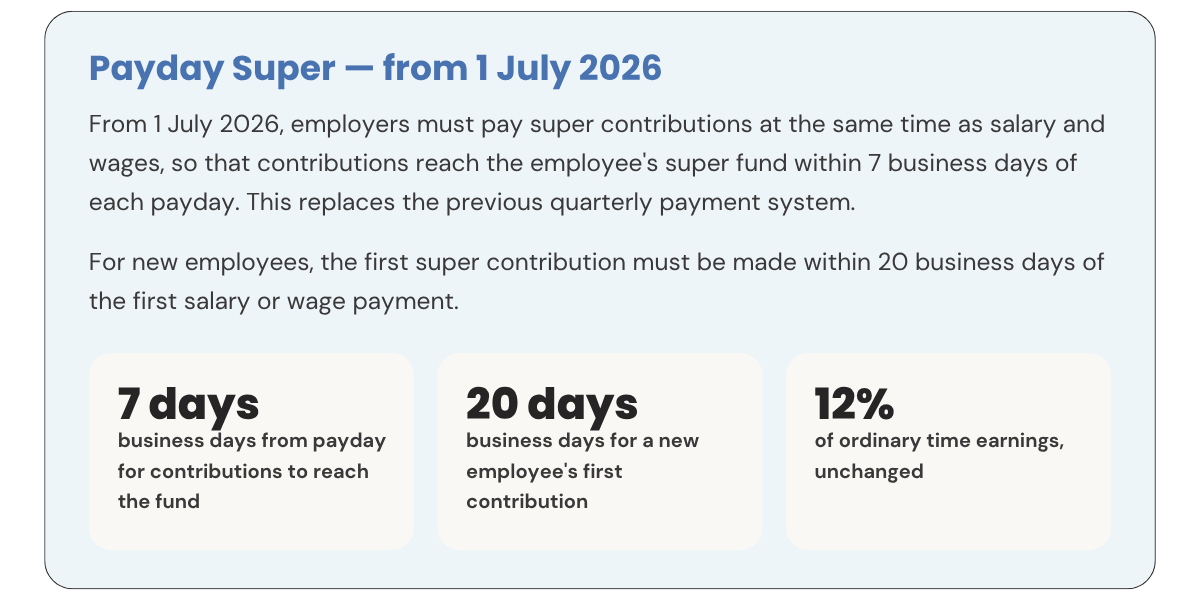
From 1 July 2025, the Superannuation Guarantee (SG) rate increased to 12% of an employee's ordinary time earnings, and it stays at 12% for 2026-27. This rate applies to all salary and wages paid on or after 1 July 2025, even if some or all of the pay period occurred before that date.Before 1 July 2022, you only needed to pay super guarantee if you paid your worker $450 or more (before tax) in a month. As of 1 July 2022, employers are required to pay super guarantee for all eligible employees, regardless of how much they are paid.
Payday Super
From 1 July 2026, Payday Super changed how and when super is paid. Instead of paying quarterly, employers must pay super guarantee at the same time as wages, for every payday. The contribution needs to reach the employee's super fund within 7 business days of payday (this is not same-day super, just a tighter deadline), and it's calculated on the employee's qualifying earnings rather than only ordinary time earnings. Missing the 7-day window can trigger the new super guarantee charge, including an added administrative uplift penalty on top of the shortfall.
WEBINAR ON-DEMAND
Pay Day Super is Here - Is Your Payroll Ready? Pay Cat Head Trainer, Tasya walks through exactly what's changed, what it means for your payroll, and how to get set up with the right clearing house solution.
Notice of Temporary Close-Downs
If you want your employees to take paid annual leave while you temporarily close down, the affected employees must be given at least 4 weeks notice of the close-down period.
With this notification, you can then require employees to take a period of paid annual leave.
Want to Cut Your Payroll Processing Time by Up to 90%?
Many of our clients skip the manual process altogether and make the shift to Pay Cat Payroll (powered by Employment Hero), with our team managing the transition for you.
Here's how Pay Cat Payroll works:
- Timesheet Approvals On the Go
No more manual entries or paper timesheet approvals. Supervisors and managers approve timesheets on the go, directly in Pay Cat Payroll.
- Automated Modern Awards Compliance
Pay Cat Payroll's pre-built modern Awards make it easy for payroll managers to pay staff correctly, each and every pay run.
- Automated Payslips
Create and customise Fair Work compliant payslips that are easy to access in Pay Cat Payroll.
- Cut Payroll Processing Time by Up to 90%
No back pay calculations. No inefficient manual interpretation. No data re-entry. Just faster, stress-free paydays.
Who is Pay Cat?
Simplify Payroll. Stay Compliant.
Pay Cat helps Australian businesses take the stress out of payroll and stay fully compliant with modern awards. As Employment Hero Payroll experts, we set up systems that cut down on mistakes, save hours each pay run, and keep your business on the right side of Fair Work.