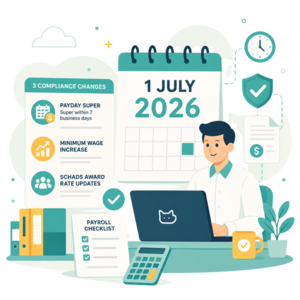
Every year, 1 July brings payroll changes. This year, it's bringing three at once.
From 1 July 2026, employers will need to navigate Payday Super, a new national minimum wage, and updated SCHADS Award pay rates, all taking effect on the same date. For HR officers, payroll teams and operations managers in the care sector, that's a significant amount to have sorted before the financial year rolls over.
This article breaks down each change and what you need to do before 30 June.
From 1 July 2026, super must be paid within 7 business days of each payday. Under the current system, super can be paid quarterly, up to 28 days after the end of each quarter. That changes completely.
The total amount of super you owe doesn't change. The Super Guarantee rate stays at 12%. What changes is the timing. Super shifts from a quarterly liability to a pay-cycle cash outflow.
At the same time, the ATO Small Business Super Clearing House closes permanently on 30 June. If your business uses it to process contributions, you need a SuperStream-enabled alternative set up before then.
What to do before 1 July: Review your payroll cycle and confirm super can be processed and authorised alongside each pay run. If you're on the SBSCH, set up your alternative now. Check that your payroll system is calculating super correctly on all applicable earnings. Errors that were manageable quarterly become compliance risks every pay run.
FREE WEBINAR
We ran a webinar with a guest speaker from Beam Super Clearing House covering Payday Super and super payment automation in detail. You can watch the replay here: Payday Super + Super Payment Automation
Change 2: National Minimum Wage Increase
The Fair Work Commission handed down its annual wage review decision on 2 June 2026, with new rates taking effect from the first full pay period on or after 1 July 2026.
The national minimum wage increases to $26.44 per hour (or $1,004.90 per week for a 38-hour week), up from $24.95 per hour. That's a 6% increase.
For most care sector employers covered by the SCHADS Award, your staff won't be paid at the national minimum wage rate — they'll be paid to their SCHADS classification level, which is covered in Change 3 below. But if you have any employees whose pay sits at or near the minimum wage floor, you'll need to update their rate before the first pay run of the new financial year.
What to do before 1 July: Check whether any of your employees are on minimum wage rates and update their pay in your payroll system before the first pay run of the new financial year. If you're using Pay Cat, updated rates are reflected in the system as soon as they're confirmed.
Change 3: SCHADS Award Pay Rate Updates 2026
Updated SCHADS Award pay rates also take effect from 1 July 2026, flowing from the Fair Work Commission's annual wage review decision handed down on 2 June 2026.
The Commission awarded a 4.75% increase to modern award wages. The specific updated pay rates across all SCHADS classification levels will be published by the Fair Work Ombudsman in the coming weeks. We'll update this article with the confirmed figures as soon as they're available.
For NDIS providers, home care and aged care organisations, this means reviewing pay rates across all classification levels before the new financial year. Given the complexity of SCHADS loadings, allowances and broken shift provisions, getting this right in your payroll system before 1 July (not after) is important.
What to do before 1 July: Watch for the updated SCHADS pay guides from Fair Work and update your classification rates in your payroll system as soon as they're confirmed. Don't wait until the first pay run of the new financial year to make the change. If you're using Pay Cat, we'll update rates in the system as soon as they're confirmed and let you know.
What Employers Need to Do Before 1 July 2026
Three changes, one date. That's not typical.
Payday Super changes when super gets paid. The minimum wage increase changes base rates. Updated SCHADS rates ripple across your entire pay structure if you're a care sector employer. None of them are small adjustments, and they all land at the same time.
The businesses that get through 1 July without a payroll headache will be the ones that treat June as a compliance month, not a catch-up month.
How Pay Cat Handles Payday Super and SCHADS Rate Updates
Pay Cat is payroll software built specifically for SCHADS Award compliance. We track every update to the award, and when our clients need support, they talk to real people who know their setup.
SCHADS pay rates are updated in the system as soon as they're confirmed by Fair Work. Super is calculated automatically on the correct earnings. And with Beam integrated for super payments, contributions can be submitted and tracked directly inside Pay Cat without separate clearing house steps.
If you want support reviewing your payroll setup ahead of 1 July, our team is here to help.
We help businesses simplify complex pay runs and stay 100% compliant under modern awards, all powered by Employment Hero Payroll.